Floor Coverings Installed - Installations Done Right


Home About Us Contact Us FeedBack

Our job is simple...to provide you with a professional
 and courteous floor covering installation service!


» Bookmark This Page

Our Services
Estimate Request
FAQ's
Knowledge Base
Plans & Measurements
Job Photo Gallery


Want to know what separates us from the rest?

Do You Need Pricing Information? Or an estimate?

Do you need advice or questions answered?

You need to see photos of our flooring installations!

Would you like references?

Would you like to see our resumes?

ready to schedule an appointment!?


What is laminate flooring?

Laminate is a recent development in the flooring industry, introduced in the US in 1996. The surface of laminate is typically made of an extremely tough-wearing aluminum oxide with a printed photograph adhered to the surface which gives it that hardwood look. The core of the laminate is usually made of high density fiberboard. This construction allows laminate flooring to look good while at the same time being both affordable and durable. Laminates are a great addition for any high traffic area.

Though laminate flooring was introduced in the United States in 1996, it has been sold successfully in Europe for about 20 years.

Most people have never heard of laminate flooring and have no idea what it is. But chances are, those same people know what Pergo flooring is. Well, Pergo is laminate flooring. They were the company that first created this type of flooring, and was the first brand of laminate offered in the United States. For this reason, its name has become synonymous with laminate flooring despite the presence of about 40 other brands.

Essentially all laminates are composed of three layers.

The Surface Wear Layer.
The surface layer is typically made of an extremely tough-wearing aluminum oxide. The pattern that you see as you look at the floor is actually that of a printed photograph adhered to the clear surface. Many people consider the pattern an additional layer, but for simplification, we consider them as one. Many laminates look like wood floors, but it’s merely a photograph of a wood floor applied to a melamine laminate. Because you can photograph nearly anything for a floor, there are few limitations. Most, though, are wood-, stone-, brick- and tile-based.

The Core.
The core board or “carrier board” is made up of a variety of materials, depending on the manufacturer. Most manufactures use HDF, or high density fiberboard, which is a durable engineered wood product that resists moisture. Others can have a high-density wood particle core. While the HDF may be slightly more structurally sound, the particle core absorbs glue slightly better at the joints. Both materials, if manufactured by dependable companies, provide a durable, trustworthy core.

Backing.
The backing board varies depending on who makes the floor, but it ranges from a paper layer to a full plastic laminate layer. Those with a laminate or melamine backing may be better against potential water damage than those with paper backings, and the laminate is more stable.

All of these layers are fused by heat and pressure either by direct-pressure or high-pressure construction. A direct-pressure laminate (DPL) is assembled at once, then heated and pressed to form a bond. High-pressure laminate (HPL), on the other hand, involves treating the top and bottom layers separately and then fusing them to the core layer under extreme pressure. HPL is a more recent innovation and is often found in the more expensive premium brands

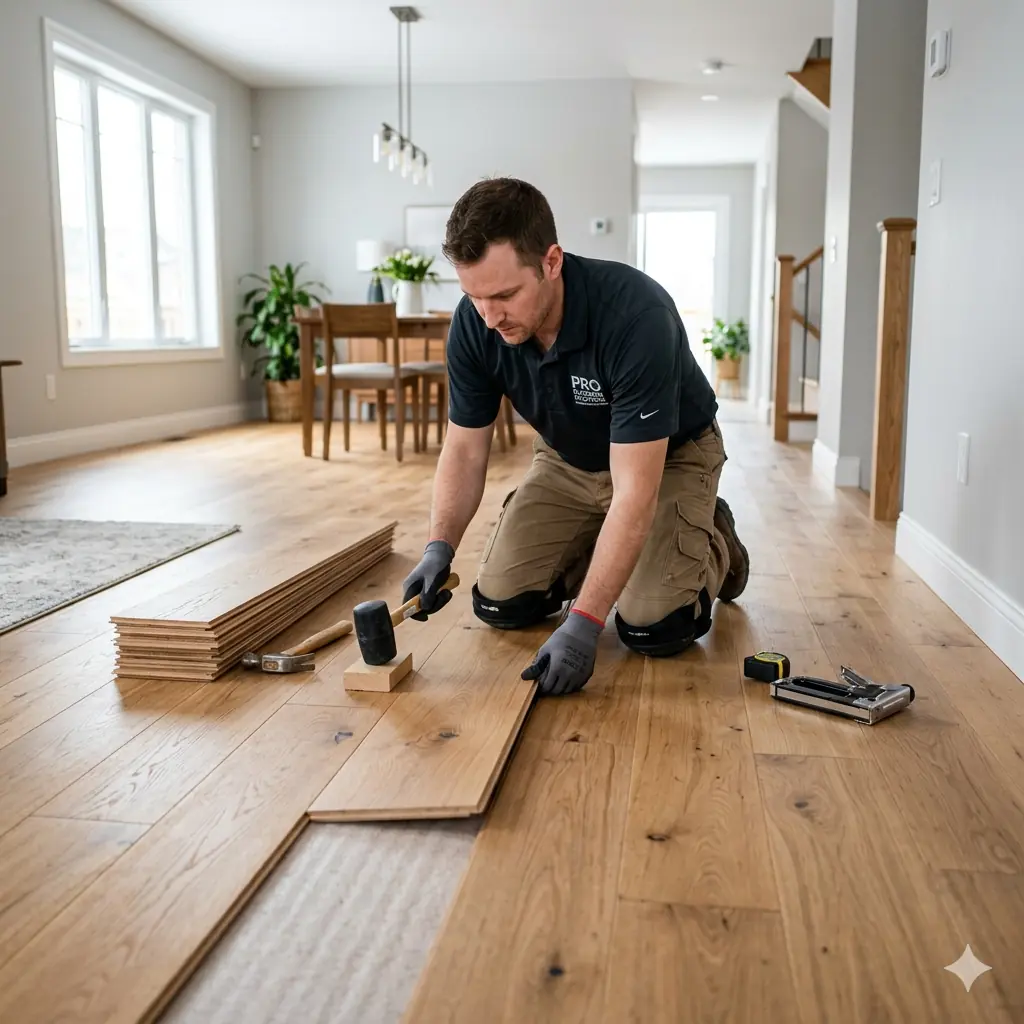
Installation Laminate flooring comes in individual boards with tongue-and-groove edges, roughly eight inches by four feet long. Matching trim and molding is available.

Laminate is installed as a “floating floor.” A layer of foam is placed under the flooring and the individual “boards” are glued at the tongue and groove joint. The individual pieces of laminate flooring are not glued or nailed down to the subfloor.

With regard to sub flooring, there’s lots of flexibility. Laminate can be installed over concrete, plywood, or orient srand board (OSB) sub flooring. And while other forms of flooring may not be suited for some types of existing floor, laminate can be applied directly over ceramic tile, vinyl, and parquet floors. Laminate’s 1/3-inch thickness is also an asset when dealing with transitions (vs. a typical 3/4-inch, Swedish-finish wood floor). Remember, any time you install a floor, it should be at the same height as adjoining floors.

Why Choose Laminate?
Where cost is concerned, professionally-installed laminate floors cost approximately the same as a Swedish-finished hardwood floor. So why choose it in the first place?

Depending on the sub flooring, solid wood may not be a possibility.

Also, laminates are extremely durable and are great for homes with a high degree of foot traffic (children and pets add significantly to traffic in a home). They are incredibly easy to maintain and will not fade, even in direct sunlight.

Most laminate flooring comes with a triple warrant against wear, staining and fading. Some manufacturers also offer moisture warranties, but look closely at the warranty itself. Many are really just an extension of your homeowner insurance. But if your insurance company doesn’t cover the damage (but they usually will), the flooring manufacturer may cover a portion of it. Either way, make sure you know what you’re getting before you buy.

Limitations
At Floor Coverings Installed, we don’t recommend installing laminates in wet areas such as bathrooms and laundry rooms. Water on the top layer will not damage it as it would hardwoods, but problems can develop when moisture works its way along the edges or underneath. With some installation modifications, laminate can work for a wet area. But do check with the installer. In general, though, we recommend tile or vinyl for wet areas.

Another issue, which some people consider a limitation, is strictly a matter of personal choice. Because laminate is a floating floor, they produce a slight tapping sound as you walk on it. Some manufacturers have introduced acoustical padding to muffle the sound with varying results. It’s a good idea to test it by walking on a dealer display floor and imagining how it will sound in your home. We recommend cork Underlayment for any floating floor as the BEST method of reducing the echo effect or tapping sound.

Waste Factor
Purchasing additional hardwood flooring is like insurance since the last thing you want is to be 95% of the way through your hardwood floor installation only to find that you’ve run out of floor. At that point, you would need to order more flooring, wait for it to arrive, and then get your contractor back and arrange another appointment.

The additional square footage ordered is commonly referred to as a “waste factor”. During installation, boards are cut to specifically fit your floor. However, once the board is cut (particularly if it is cut at an angle) you may not be able to use the rest of the board less you have a short board that sticks out like a sore thumb.

In addition, hardwood floors often have a lot of character to them as they’re a natural product. Particularly during the installation of lighter hardwood floors, you may not always want that character. So you may find yourself not wanting to use a board that is a little darker than the rest.

Finally, you may want to repair a spot of the floor down the road or you may discover that you really did want to put a floor in that hallway closet after all. Since many manufactures discontinue flooring lines now and then, you might find yourself in a situation where you can’t buy the same flooring. By having it on hand, you insure that you can use it in the future. For this reason, Floor Coverings Installed automatically adds 10% to your order for you. It’s always marked separately so if you’ve taken your waste factor into account, you can always remove this from your order.


[Home] [Up] [Our Services] [Estimate Request] [FAQ's] [Plans & Measurements] [Job Photo Gallery]

Send mail to webmaster@FloorCoveringsInstalled.com with questions or comments about this web site.
Copyright © 2007 Floor Coverings Installed™